Anaconda, Colorado
Gold miner Bernard Harvey and Mary Gregory were married in County Armagh in the parish of Creggan, Northern Ireland on 22 Oct 1894. Just 12 days later, they were on a boat heading back to their home in Aspen, CO. The 1900 census has them residing in the then gold mining town of Anaconda, CO. About 1902, Mr. Harvey tried to organize a miner’s union, but was put on a train bound to Kansas. His wife remained in Anaconda, running a boarding house, until he settled and called for her and the family in Rhyolite, NV.
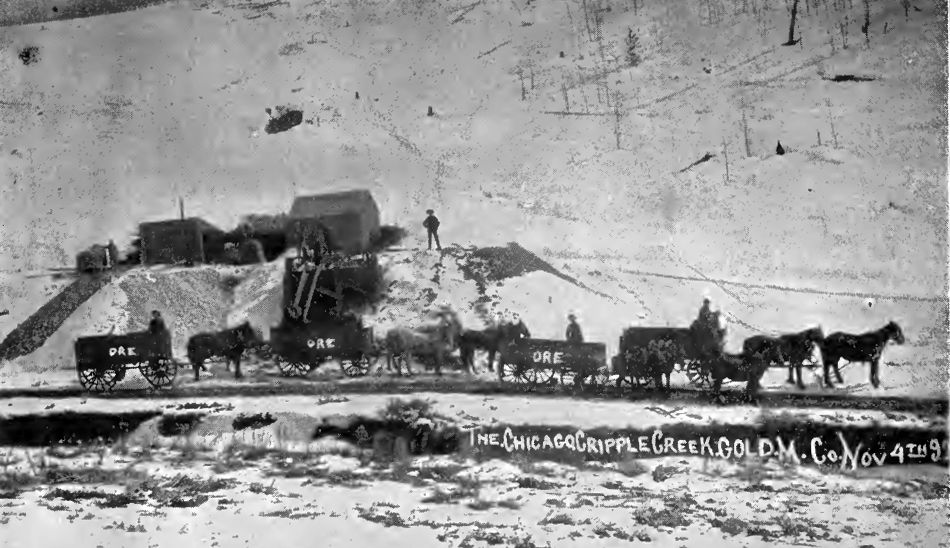
1893 photo for the Chicago Cripple Creek Mining Company at Cripple Creek
While many assume that workers in the nineteenth-century American West enjoyed easily available land and a fluid social structure, the region’s history of radical unionism at the turn of the century suggests otherwise. In 1902, corporate mining interests in Colorado decided to crush the Western Federation of Miners (WFM). By the following year, civil war erupted in Cripple Creek, Colorado, as state and local officials and local businessmen joined with the large corporations against the miners. Before it was over, thirty men had been killed in numerous gun battles. Documents gathered as part of a 1905 federal investigation included a yellow dog (anti-union) contract that prospective mining employees were required to sign. The documents also included a letter from mine owners asking landlords not to lease property to union sympathizers; a resolution by the Denver Citizen’s Alliance attacking the WFM; orders directing Colorado National Guard troops to deport 73 striking miners and their leaders to Kansas; and finally a plea by a Colorado union official to the Red Cross for the organization’s aid.
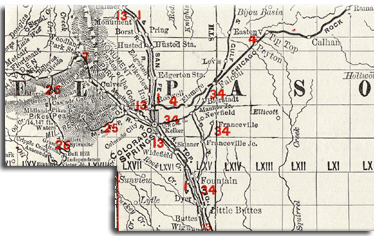
A cowboy and part time prospector named Bob Womack discovered gold in Cripple Creek, CO in 1890. The three square mile district became home for more than 50,000 people by 1900. To put things in perspective, the gold mined in this area was greater than any other gold mining operation ever conducted in the United States combined. Other towns in the area included Goldfield, Elkton, Altman, Independence, Anaconda, Gillette, Cameron, Beaver Park, Arequa and Lawrence. Goldfield and Gillette are the only two which remain. Anaconda’s peak population was about 1,000. Founded in 1894, the town was sprawled along a half mile of Squaw Gulch, about halfway between Cripple Creek and Victor. It was originally located in El Paso County, but on 23 March 1899, Teller County was formed from land from El Paso and Fremont Counties.
 |
Before 1890 most of Teller County was uninhabited. It was an area that people traveled through to get somewhere else via the old Ute Pass Trail which was an important route because it offered passage through the front range of the Rockies for Indians, buffalo, explorers, prospectors, and cowboys and their cattle.
Originally started as a miner’s town, Anaconda grew out of convenience and necessity. With so many big mines concentrated around Squaw Gulch, it was only natural that the people working them would want to live nearby. Among the big gold mines in or near Anaconda were the Mary McKinney, the Anaconda, the Doctor Jack Pot, the Chicken Hawk, the Dolly Varden and the Morning Glory. With those industrial enterprises supporting the town, unemployment was not a problem.
Unlike some of the other towns of Cripple Creek, Anaconda developed its own business district. According to the book “Ghost Towns” by Leland Feitz, Anaconda sported its own hotels, saloons, drug and grocery stores, doctors, lawyers, printers, music teachers, dressmakers, an optician, and even an artist. As was the custom, the town had a nice school house and several churches. The town even had its own jail.
The merchants of Anaconda howled and complained when customers paid for goods and groceries with “worthless” Mary McKinney stock. But those who took the stock could not have been entirely displeased with the company’s steady history of dividends or the $11 million in gold it produced.
The mine itself had the last laugh, however. A tenderfoot doing lease work in the Mary McKinney Mine touched off a powder box with an experimental electric shooter. A hole was blown in the roof of the shaft house and the town was showered with rocks. Town wags said the hole was caused by a pump blown up from the bottom of the shaft. Conventional wisdom held that a pump blown out with that much force would not return to Earth “for at least two days.”
 |
For the most part, Anaconda was a peace loving town. It did not have near the population of Cripple Creek or Victor, and fewer recreational facilities existed there. Consequently, most of the hard drinkers and hell raisers went to the bigger cities to celebrate the end of the work week. In one of life’s little ironies, the Arno Mine, located within the town limits of Anaconda, was a stronghold for some of the District’s outlaws.
It would be less than truthful to describe Anaconda as a quiet town though. Imagine living in a town where your neighbor’s house is about an arm length from yours and you can hear his every move. Add the noise from the constant hustle and bustle of people in the nearby saloons and shops at all hours of the day and night. To this, add the non-stop clattering of horse hooves and mine machinery. Then factor in the loud whistles from 16 nearby mines announcing three shift changes per day. Top this off with the sound of 67 trains circling completely around your town everyday. Remember that you also live in a gulch that has a powerful echo. One could forgive the fine people of Anaconda for being a little cranky now and again.
Anaconda hit its peak just as the Golden Era of the Cripple Creek District ended. With gold production in decline and the deep levels of the mines flooding, Anaconda was poised to begin a decline of its own. During the winter of 1904, a fire started that pretty much annihilated the town. Unlike the massive relief efforts that rebuilt Victor and Cripple Creek after their fires, Anaconda was left to die a slow death. After the fire, most residents simply moved away. Anaconda’s population fell from 1,000 to 250 and continued a steady decline. The mines were still in operation, but the town would never be the same.
|
PRINCIPAL MINES in the CRIPPLE CREEK MINING DISTRICT – 1899
|
|||||
|
Mine
|
Year
|
Monthly Output
|
Mine
|
Year
|
Monthly Output
|
|
Independence
|
1892
|
$60-75,000
|
Abe Lincoln
|
1895
|
$10-15,000
|
|
Portland
|
1895
|
$60-75,000
|
Rebecca
|
1891
|
$20-25,000
|
|
Legal Tender
|
1893
|
$15-20,000
|
Victor
|
1892
|
$50-60,000
|
|
Lincoln
|
1891
|
$10-15,000
|
Isabella
|
1892
|
$35-45,000
|
|
El Paso
|
1892
|
$40-50,000
|
Elkton
|
1892
|
$70-80,000
|
|
Pike’s Peak
|
1894
|
$20-25,000
|
Gold Coin
|
1896
|
$20-25,000
|
|
Doctor
|
1895
|
$30-35,000
|
Pharmacist
|
1892
|
$10-15,000
|
|
Vidicator
|
1895
|
$8-10,000
|
Anchoria-Leland
|
1894
|
$50-60,000
|
|
Xmas
|
1895
|
$6-8,000
|
Moosh
|
1893
|
$30-40,000
|
|
Moon Anchor
|
1895
|
$15-20,000
|
Anaconda
|
1892
|
$40-50,000
|
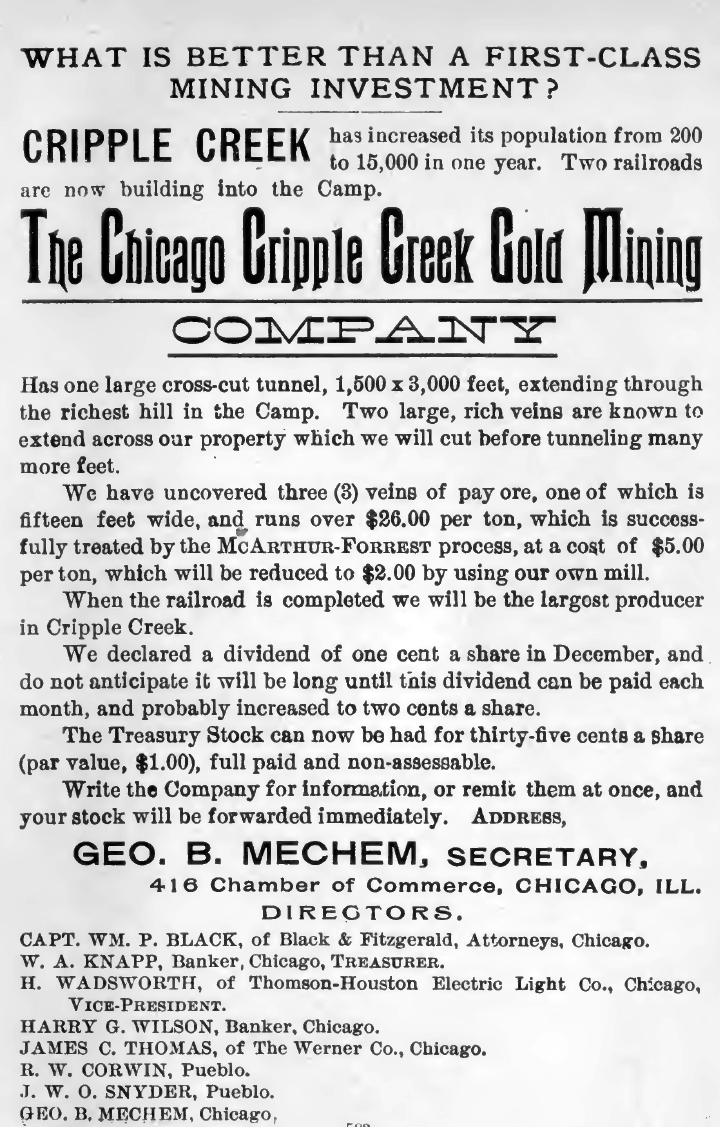
1893 advertisement for the Chicago Cripple Creek Mining Company
From the Standard Guide to Chicago of 1893:
Cripple Creek Mining Co.. Mining has again taken its place as one of the leading industries of the country, and capital is once more flocking to the West, looking for investments of this class. This state of affairs naturally develops more property, and during the last year Colorado has been the scene of more activity in the opening and development of its mines.
All the old camps are doing a little better, and several new ones have claimed the attention of mining men. First came Creede, a noted silver camp, which developed in a short time three or four of the best silver mines in Colorado. Next came Cripple Creek, at the foot of Pike’s Peak, and laid claim to the first place as a gold producer in Colorado, and from present indications it will retain this rank, not only in Colorado, but in the United States. While speaking of Cripple Creek it might be well to note that, first, it is exclusively a gold camp, very little silver being found anywhere within its region. It was only discovered in the spring of 1891 and up to November of that year it had a population of but 200. January, 1893, gives them a population of something like 15,000 people, permanent residents; a flourishing city of 5,000 people ; large, magnificent hotels, business houses and electric light. Two railroads are building into the camp, one over the Midland route, which is now practically completed, and the other from Florence.
This has all tended to claim the attention of investors all over the United States to the wonderful camp of Cripple Creek. Within the last twelve months it has developed something like forty shipping mines, and with the advent of the railroad this number will probably be increased to 150. It will then not only stand first place as a gold camp but first place among all mineral camps. Some of the mines of this camp have a wonderful history. The Gold King was owned by a man who conceived the idea that he would rather be in possession of an ordinai’y plug horse, and conseqiiently exchanged his claim for the horse. So far as heard frpm the hoi-se has not increased very much in value, but the mine has run up to $1,000,000. The Anaconda property was offered for $500 when it was a bare claim; now it has a capitalization of $5,000,000,with stock advancing every day and will probably be at par before long. The Chicago-Cripple Creek Gold Mining Co., whose property is probably the best located in the camp, and whose value is conceded to stand well to the front, if not first, have developed all their property within the last ten months. It is wonderful what a change can be made in that time. The last mentioned property was nothing but a bare prospect ten months ago, while now it is a magnificent mine. A large tunnel big enough for two railroad tracks extends into the hill something over 500 feet. Numerous large bodies of ore have been uncovered, and still they are reaching into the depth of the hill for more, with every indication of success The officers of this company are mostly Chicago people and are men of high business standing,which fact has tended to give them an advantage over most others.
Their office is at 416 Chamber of Commerce, Chicago, IL. The Mollie Gibson mine is another property in Colorado that has given great returns on the investment, stock going from five cents a share to as high as $12, and fifteen cents a share has been paid every month as dividends. The Bassick mine is another property with quite a history. It was discovered by Mr. Bassick eight or nine years ago, and he did not have enough money to pay the assay test, $1, but during the year he took out a half million dollars in gold and at the end of the year sold the mine for another half million cash. The parties to whom the Bassick was sold took out a million and a half the next year, and then they got into litigation and the mine has been tied up since then until a few days ago’. A syndicate, headed by Hon. Warner Miller, of New York, has now taken charge and no doubt it will prove to be equal to what it was in the past. It is noticeable that there is a greater number of conservative business men quietly taking large interests in mining property than was to be seen ten years ago. The large amount of gold taken out of California in ’49 and ’50 was the means of making gold at a discount for the first time, and it is asserted with many grounds for belief that the output of Cripple Creek will be the means of equalizing the values of gold and silver.
Gregoryology Facebook Group

 Chicagology
Gregoryology Facebook – Moved to Group
A Word From Our Sponsors